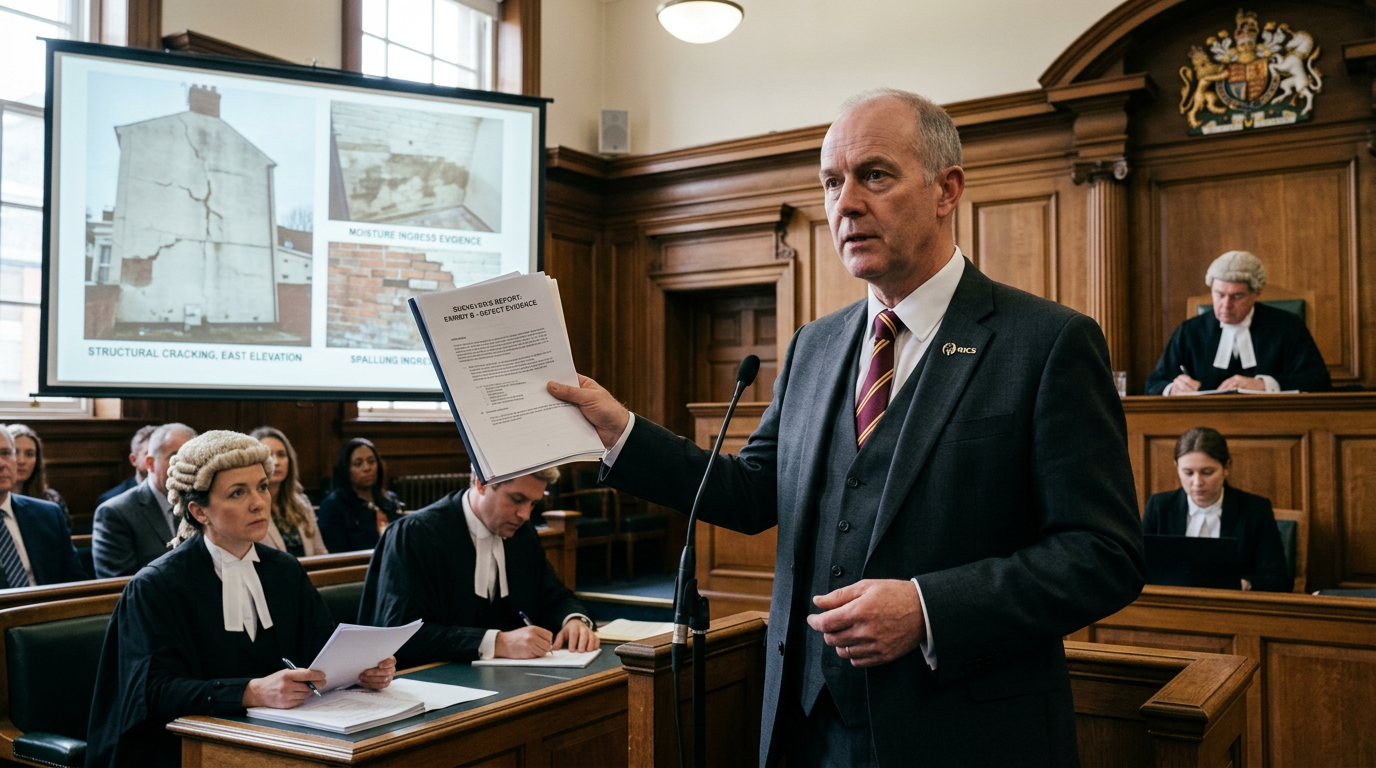
Property disputes are among the most technically complex matters that come before civil courts and tribunals in England. Judges are legal experts — not building experts. When a court needs to understand whether a wall was structurally defective, whether a contractor built to a professional standard, or whether a surveyor's report correctly identified a defect, it relies on expert witnesses: independent professionals with the technical knowledge and experience to give the court an objective, informed view.
I am Robert Ashley, a building surveyor based in Crowborough with extensive experience as an expert witness in property and construction disputes across East Sussex, Kent, and the wider South East. In this guide, I want to explain what an expert witness surveyor actually does, what the legal obligations are, and how to work effectively with one if you are facing a property dispute.
What Types of Property Disputes Need an Expert Surveyor?
Expert surveying evidence is commonly required in the following types of property dispute:
Defective Building Works
Claims against builders, contractors or architects for poor workmanship or design failures.
Surveyor Negligence
Claims that a surveyor failed to identify defects that a competent surveyor should have found.
Boundary Disputes
Expert measurement and interpretation of deeds, maps and physical features to establish the legal boundary.
Dilapidations
Disputed schedules of dilapidations at the end of commercial leases — establishing condition and liability.
Nuisance Claims
Water ingress, subsidence, or other physical damage allegedly caused by a neighbouring owner's actions or inactions.
Party Wall Disputes
Appeals against party wall awards, or disputes about damage allegedly caused by notifiable building works.
Insurance Claims
Expert assessment of the cause and extent of structural damage for insurance purposes or disputed insurance claims.
Landlord & Tenant Disputes
Repairing covenant obligations, service charge disputes, and condition assessments in leasehold property matters.
The Expert Witness's Duty: CPR Part 35
The rules governing expert witnesses in civil litigation in England and Wales are set out in Civil Procedure Rules Part 35 (CPR 35). The fundamental principle is clear and non-negotiable: the expert's overriding duty is to the court, not to the party instructing them.
CPR Part 35.3 — Expert's Overriding Duty
"It is the duty of experts to help the court on matters within their expertise. This duty overrides any obligation to the person from whom experts have received instructions or by whom they are paid."
This is a duty that is taken extremely seriously by qualified expert witnesses — and rightly so. An expert who simply argues their client's case, regardless of the evidence, is not acting as an expert witness: they are acting as an advocate, which is the solicitor's role, not the surveyor's. Courts quickly identify partisan experts, and their evidence is given minimal weight. Worse, a surveyor who produces a biased expert report faces disciplinary action from their professional body and potential civil liability.
What this means in practice is that when I accept instructions as an expert witness, I make clear from the outset that my report will reflect my honest professional opinion. If the evidence does not support my client's case, I will say so — and in my experience, clients who receive this advice early are far better served than those who pursue litigation on the basis of a biased report that falls apart under cross-examination.
Single Joint Expert vs Party-Appointed Expert
In many property disputes before county courts and tribunals, the court will direct that a single joint expert (SJE) be appointed — a single surveyor agreed between both parties who reports to the court on behalf of both sides. This is efficient, cost-effective, and increasingly the court's preferred approach in lower-value disputes.
In higher-value or more complex matters, each party may appoint their own expert. The two experts produce separate reports and, if their opinions differ, are typically required to meet (a "without prejudice" meeting of experts) to identify the areas of agreement and disagreement, and produce a joint statement. At trial, both experts give evidence and may be cross-examined. The court then decides which expert's evidence it prefers, on the basis of the quality and objectivity of each report and the persuasiveness of each expert's oral evidence.
What an Expert Witness Report Contains
A court-compliant expert witness report (CPR Part 35 compliant) must follow a specific structure. Here is what a well-drafted building surveyor's expert report typically contains:
- Introduction and InstructionsSets out who the expert is, who they have been instructed by, and the questions they have been asked to address.
- Expert's Qualifications and ExperienceDemonstrates that the expert has the relevant technical knowledge to give the opinions expressed in the report.
- Documents ConsideredLists all documents, reports, photographs and other materials the expert has reviewed in forming their opinion.
- Inspection and MethodologyDescribes the inspection carried out, the date, conditions, areas covered, and any limitations on the inspection.
- Findings of FactSets out what the expert found — the observable condition of the building, identified defects, measurements and test results — stated factually and without opinion.
- Expert OpinionThe expert's professional analysis and conclusions, answering the questions posed in the instructions. Where there is a range of professional opinion, this is explained.
- Summary of ConclusionsA concise summary of the expert's main conclusions, cross-referenced to the opinion section.
- Statement of Truth and Declaration of IndependenceA signed declaration confirming the expert understands their duty to the court, that the report contains their true and complete opinion, and disclosing any conflict of interest.
Case Study: Surveyor Negligence in Crowborough
I was instructed as an expert witness by a couple who had purchased a Victorian detached house in Crowborough. They had relied on an RICS Homebuyer Report prepared by a local surveyor. Within six months of purchase they discovered that the property had severe roof timber decay, active woodworm infestation throughout the first floor, and a partially collapsed chimney stack — none of which had been identified in the Homebuyer Report.
My expert report examined the Homebuyer Report and compared the surveyor's findings with the actual condition of the property at the date of inspection. I found that the roof was accessible by ladder and the decay was extensive and visible. The woodworm infestation was widespread and showed visible emergence holes in the floor joists. The chimney lean was visible from the garden with the naked eye at 30 metres.
My opinion was that a reasonably competent surveyor carrying out a Level 2 inspection to RICS standards would have identified all three issues and recommended further investigation. The Homebuyer Report, as produced, fell below the standard of a reasonably competent surveyor in all three respects.
The matter settled before trial. My expert report was the primary document in the mediation that led to a settlement in my clients' favour. The cost of instruction was recovered as part of the settlement.
Choosing the Right Expert Witness Surveyor
When choosing an expert witness surveyor for a property dispute, your solicitor should look for:
- Chartered status — MRICS or FRICS — ensuring professional accountability
- Specific technical expertise in the area in dispute (building defects, boundary disputes, dilapidations, etc.)
- Experience of producing CPR Part 35 compliant expert reports
- Experience of giving oral evidence in court — the ability to withstand cross-examination calmly and clearly
- Independence from all parties — no prior involvement in the matter and no commercial relationship with either side
- Local knowledge — particularly important in boundary disputes where knowledge of local vernacular construction and local planning history can be critical
Frequently Asked Questions About Expert Witness Surveying
How much does an expert witness surveyor cost?
Expert witness fees vary depending on the complexity of the case and the scope of the instructions. For a typical residential property dispute, expect to pay £1,500–£4,000 for a full expert report including inspection. Attendance at a meeting of experts, preparation of a joint statement, and giving oral evidence at trial will add further to this. Expert witness fees are typically recoverable from the losing party in successful litigation.
Can an expert witness surveyor give evidence in my favour?
An expert witness will give evidence that reflects their honest professional opinion — which may or may not support your case. If you want a surveyor who will simply agree with your position regardless of the evidence, you do not want a genuine expert witness. A genuine expert witness who honestly supports your case is enormously valuable; a biased one is a liability.
What is the difference between an expert witness and a surveyor's report for negotiation?
An expert witness report is prepared to be adduced as evidence in legal proceedings and must comply with CPR Part 35. It includes specific declarations, a statement of truth, and a declaration of independence. A surveyor's report prepared for negotiation purposes — sometimes called a "without prejudice" report — has no such formal requirements, but should still be objective if it is to be useful in reaching a settlement.
Do I need an expert witness for RICS Dispute Resolution Service?
The RICS Dispute Resolution Service (DRS) offers adjudication, arbitration and mediation. For RICS adjudication and arbitration, expert evidence from a qualified surveyor is usually essential. For mediation, an independent surveyor's assessment can be helpful in supporting a negotiated resolution. Our team at Crowborough Surveyor has experience of the RICS DRS process and can advise on the appropriate approach for your specific dispute.
Can the same surveyor who identified defects act as expert witness?
Generally no. A surveyor who carried out the original inspection and has become an advocate for their client's position cannot credibly claim independence as an expert witness. In practice, it is usually better to instruct a different firm with no prior involvement in the matter to provide expert witness evidence. This ensures genuine independence and prevents challenges to the admissibility or weight of the evidence.
Expert Evidence That Stands Up in Court
If you are involved in a property dispute in East Sussex that may require expert surveying evidence, early instruction of an experienced surveyor is vital. A well-prepared expert report often leads to settlement before trial, saving both parties the cost and stress of a contested hearing.
At Crowborough Surveyor, our surveyors have extensive experience as expert witnesses across a range of property dispute types. We produce CPR Part 35 compliant reports and are experienced in giving oral evidence. Contact us to discuss your matter in confidence.
Need an Expert Witness Surveyor?
Our surveyors provide CPR-compliant expert witness reports for property disputes across East Sussex and Kent.
Get in Touch