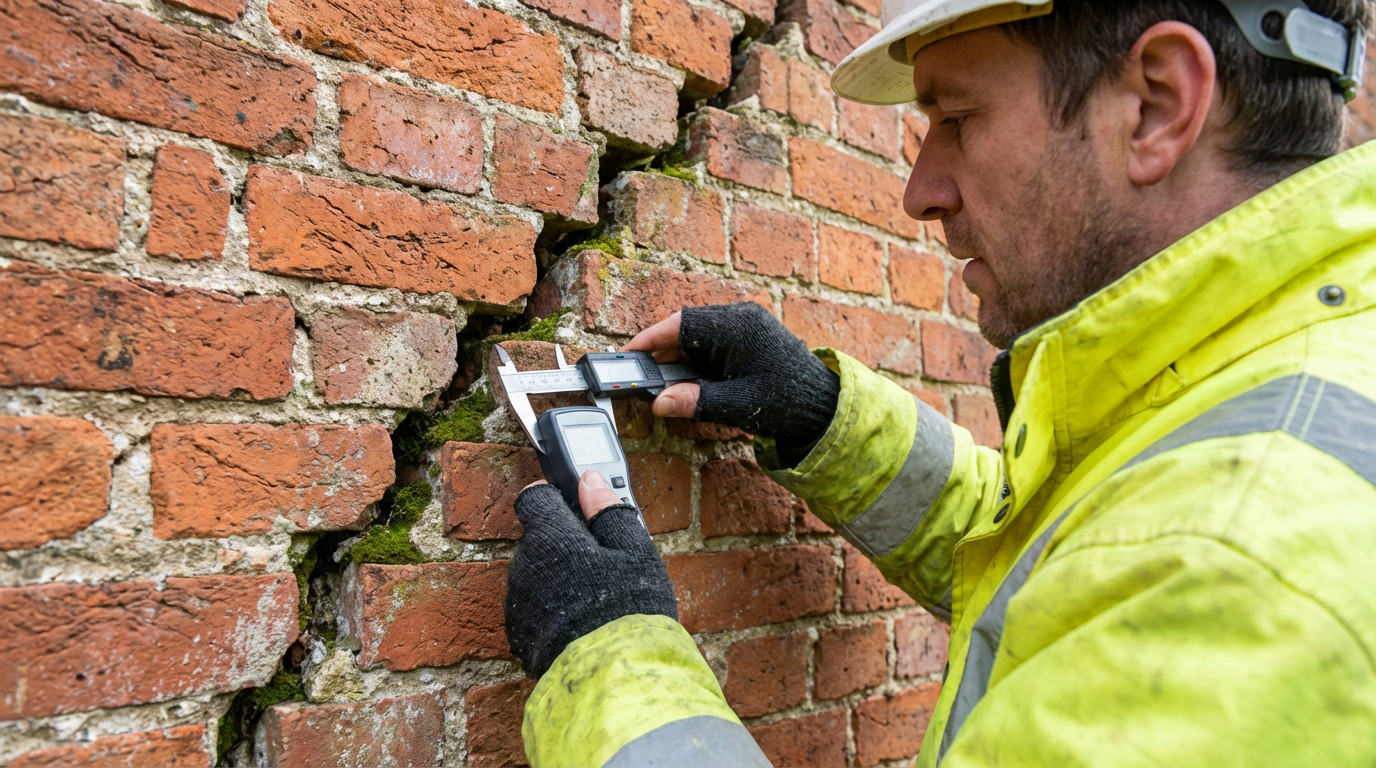
Cracks in walls are one of the most anxiety-inducing things a property buyer can find — and they are also one of the most commonly misunderstood. The truth is that virtually every building has cracks. The question is not whether cracks exist, but what type they are, how they got there, and whether they indicate something you genuinely need to worry about.
As a building surveyor in Crowborough, I look at cracks in dozens of properties every year. Here is how I assess them — and what the different types actually mean.
Not All Cracks Are Equal
The first thing to understand is that cracks have a classification system based on their width and character. The Building Research Establishment (BRE) uses a six-category scale, but for practical purposes, most surveyors work with three broad categories:
🟢 Cosmetic / Fine Cracks
Under 0.1mm wide. Hairline cracks in plaster, settlement shrinkage in new builds. Normal and expected — no structural significance.
🟡 Moderate Cracks
0.1mm–5mm wide. May require monitoring and repair. Some types indicate movement, but not necessarily progressive or serious.
🔴 Serious Cracks
Over 5mm wide, wide enough to insert a finger. Indicate significant structural movement. Requires urgent investigation by a structural engineer.
Types of Cracks and What They Mean
Hairline Plaster Cracks
Fine cracks following the line of joints in plasterboard or plaster are almost universally cosmetic. They result from the natural drying out of plaster, seasonal thermal movement and minor settlement of the building. They require filling and decorating, nothing more.
Diagonal Cracks from Window and Door Corners
A 45-degree crack running from the corner of a window or door opening is very common in older properties and usually indicates minor settlement around the opening. These are generally manageable with routine repair and repointing, unless they are particularly wide or progressive.
Staircase Cracks Following Mortar Joints
A crack that follows the stepped pattern of brick mortar joints — like a staircase — is a classic indicator of differential settlement. This means one part of the building has moved relative to another. The cause could be subsidence, heave, inadequate foundations, or the failure of a ground-floor structural element. This type of crack needs proper investigation.
Vertical Cracks Through Bricks
A crack that cuts through the brick itself (rather than following the mortar joint) suggests a significant force — either structural overloading, severe frost action, or significant differential movement. These should always be investigated professionally.
Horizontal Cracks in External Walls
Horizontal cracks in brick or blockwork are sometimes the most serious type of all. They can indicate that a wall is bowing outward under load — which can be a sign of inadequate wall ties, inadequate floor-to-wall connections, or, in retaining walls, earth pressure. If you see significant horizontal cracking, treat it as urgent.
Cracks and Subsidence: The Key Question
In the High Weald and much of East Sussex, the underlying geology includes Weald Clay — a shrinkable clay that contracts significantly in dry summers and expands in wet winters. This seasonal movement can cause foundation movement in older properties, particularly those with shallow foundations. The result, over time, is cracking — sometimes significant.
This does not necessarily mean the property is unsalvageable. Many older East Sussex properties have experienced some clay shrinkage movement over their lifetime and have stabilised. The key questions are: Is the movement current and active? Is it progressive? Are the cracks widening? A good structural survey will help answer these questions — and may recommend crack monitoring or a specialist structural engineer's report if there is genuine concern.
"I tell clients: a crack tells you that movement has happened. What you need to find out is whether it is still happening — and why." — James Hartwell
Crack Monitoring
If we identify cracks that concern us during a survey, we may recommend professional crack monitoring — the installation of tell-tales or demec gauges across the cracks to detect whether they are growing. This is typically carried out over at least one full seasonal cycle (spring to autumn) to differentiate between seasonal movement and genuine progressive settlement.
Some buyers use this as grounds for a price reduction — commissioning crack monitoring before completion, with the understanding that if movement is detected, the price is adjusted. This is a sensible approach for properties with significant cracks.
FAQs: Cracks in Walls
Concerned About Cracks in a Property?
A Level 3 building survey from Crowborough Surveyor will give you a thorough assessment of any cracking, with recommendations on further investigation and cost implications. Contact us for a free quote.
Get a Free Quote