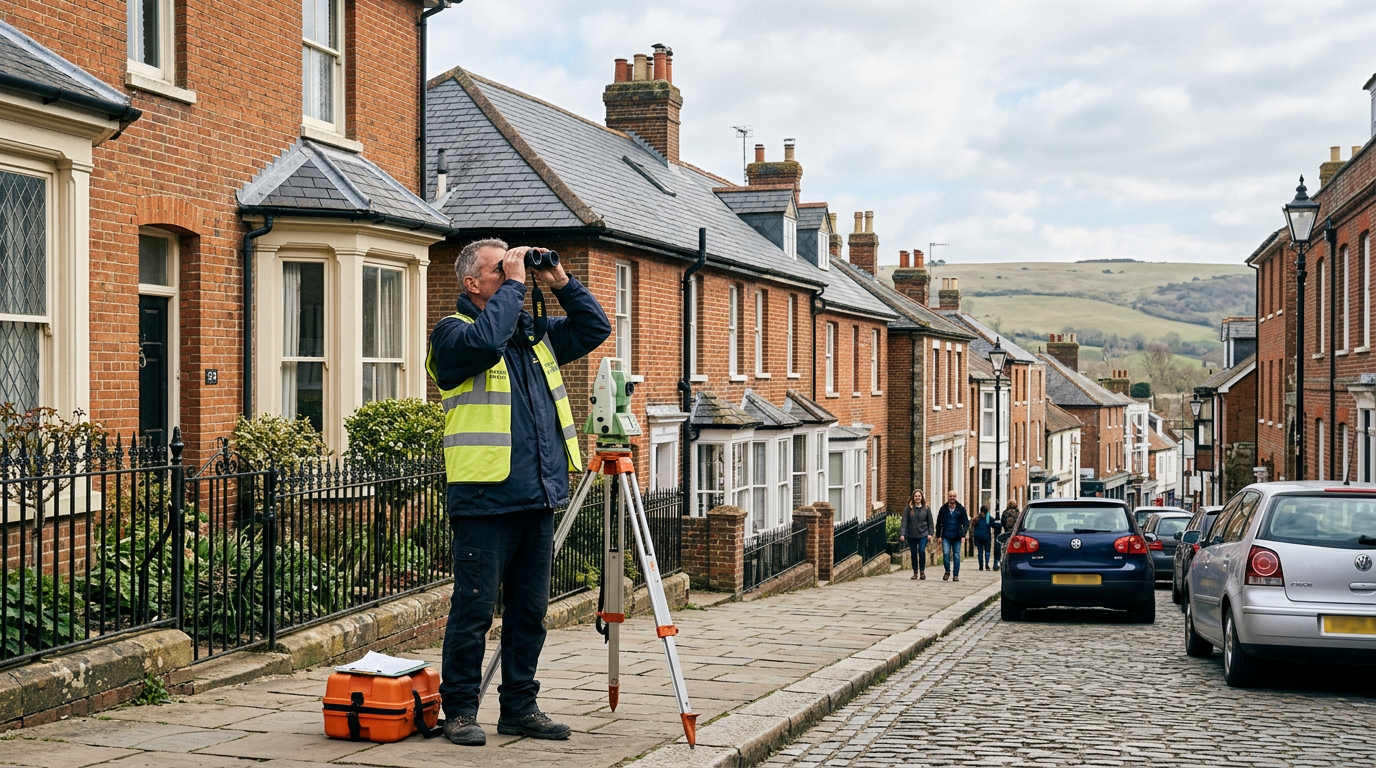
Victorian properties — those built roughly between 1837 and 1901 — make up a significant proportion of the housing stock in Crowborough and across East Sussex. They are wonderful homes: high ceilings, original fireplaces, solid brick construction and a character that modern builds simply cannot replicate. But they also come with a very specific set of defects that any buyer needs to understand before committing to a purchase.
As a building surveyor who has inspected hundreds of Victorian properties across the High Weald, I can tell you that almost every one of them will have something that needs attention. The question is whether the issues are manageable and already reflected in the price, or whether they represent a serious problem that changes the picture entirely.
1. The Roof
Victorian roofs were almost universally laid with Welsh slate — a beautiful material that, when original, is now over 130 years old. Much of it is still performing perfectly. But here is the thing: all natural slate has a finite lifespan, and Victorian slate is at or approaching the end of its useful life in many cases. We routinely find:
- Delaminating or slipping slates — caused by the natural ageing of the nail holes through which the slates are fixed. As the nails corrode and the slates develop nail-sickness, they begin to slip and fall.
- Failed lead flashings — the lead around chimney stacks, valleys and abutments degrades over time. Failed lead is one of the most common sources of water penetration in Victorian properties.
- Deteriorated chimney stacks — pointing fails, flashings fail, chimney pots crack. Victorian properties typically have multiple chimney stacks, each requiring regular maintenance.
A full roof replacement on a Victorian terrace or semi-detached in Crowborough typically costs between £8,000 and £20,000 depending on size. It is a significant item and one that will appear in your survey report if the roof is nearing end of life.
2. External Walls and Damp
Most Victorian properties were built with solid brick walls — two skins of brick with no cavity and no insulation. This construction is perfectly serviceable but has two key weaknesses: it provides minimal thermal insulation, and it is more susceptible to moisture penetration than a modern cavity wall.
Pointing deteriorates over time. When it fails, rainwater can penetrate the wall and show up as damp patches internally. Repointing a Victorian property is a manageable cost — typically £3,000–£8,000 for a full repoint of a typical semi — but it is important to use the right mortar. Victorian brickwork should only be repointed with a lime mortar softer than the brick. Using modern cement mortar on old brick is a very common mistake that causes the bricks to spall and crack over time.
Common Defects at a Glance
Ageing Slate Roof
Original Victorian slate nearing end of useful life — common in properties over 80 years old. Replacement: £8,000–£20,000.
Damp Proof Course Failure
Original DPCs (often slate or bitumen) can fail or be bridged, leading to rising damp. Treatment: £1,500–£5,000.
Failed Lead Flashings
Lead around chimney stacks and valleys deteriorates with age. Replacement: £500–£3,000 per stack.
Timber Decay
Original sash windows, fascias and structural timbers can suffer wet rot. Repair/replacement: £1,000–£8,000.
Settlement Cracking
Victorian foundations are often shallow by modern standards, making them susceptible to clay shrinkage movement.
Outdated Services
Original or partially-updated electrics, plumbing and heating may need upgrading for safety and efficiency. Budget: £5,000–£15,000+.
3. Services — Electrical, Plumbing and Heating
Victorian properties were not built for modern electrical loads. Many have had their wiring upgraded — sometimes once, sometimes multiple times — but the quality of previous electrical works varies enormously. We routinely encounter outdated consumer units, unsleeved earth conductors, and non-compliant additions to the electrical installation. A full electrical inspection by a qualified electrician (Part P registered) is always advisable when buying a Victorian property.
Original Victorian lead pipework has almost certainly been replaced in most properties by now, but older copper or iron pipework may still be present and could need updating. The central heating system — if there is one — is worth examining carefully, as Victorian properties often have inefficient or poorly configured heating systems.
Why Victorian Properties Need a Level 3 Survey
The combination of age, construction type and the range of potential defects means that Victorian properties almost always warrant a Level 3 building survey rather than the more basic homebuyer report. The Level 3 gives you a thorough investigation of all accessible elements, including the roof structure, subfloor spaces (where accessible) and any visible services. It also includes cost guidance that helps you budget realistically for any defects found.
At Crowborough Surveyor, we combine the Level 3 inspection with thermal imaging and moisture meter readings to give you the most complete picture possible of what you are buying.
FAQs: Victorian Properties in East Sussex
Buying a Victorian Property in Crowborough or East Sussex?
A Level 3 building survey from Crowborough Surveyor is the most thorough protection you can get. We know Victorian properties inside out — and we know East Sussex. Contact us for a free, fixed-fee quote.
Get a Free Quote Level 3 Survey