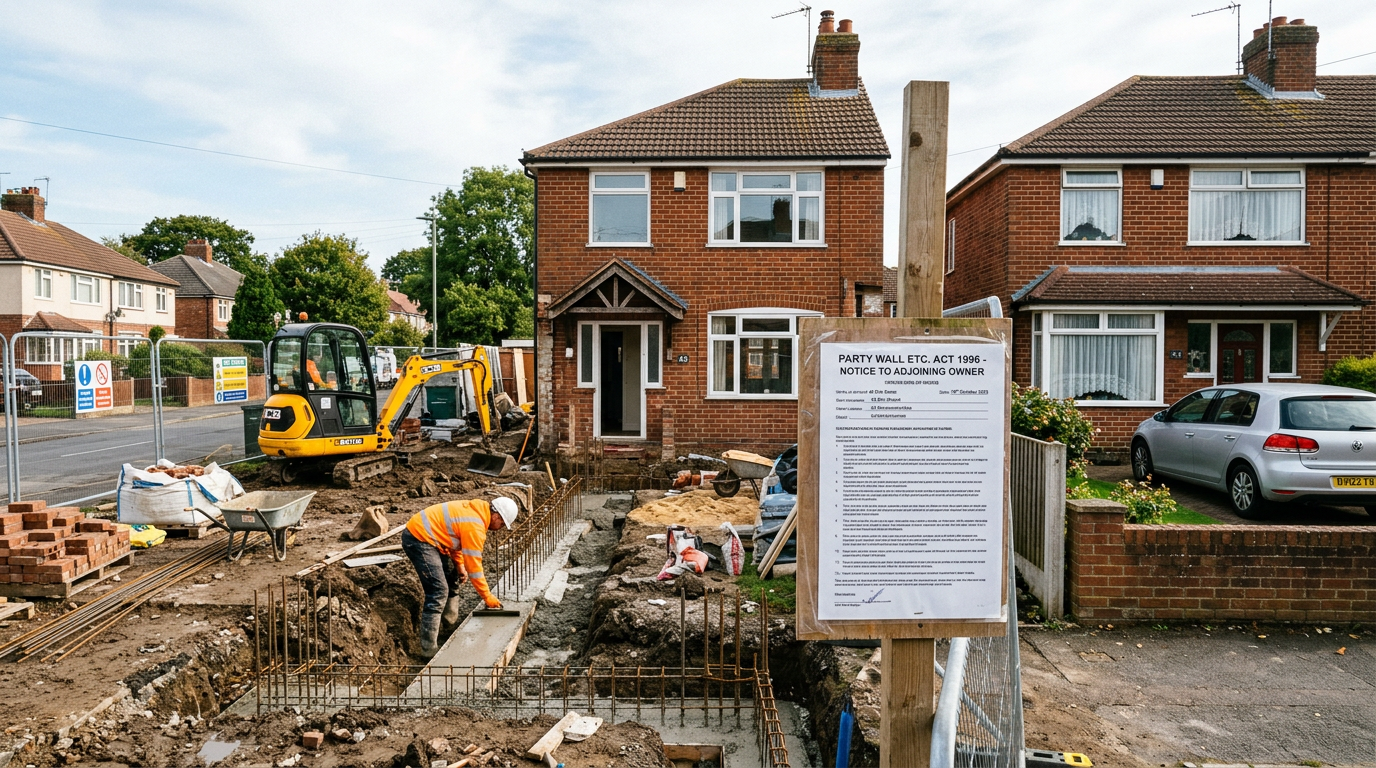
Planning a home extension in East Sussex is one of the most exciting things a homeowner can do. More space, more light, more value — the prospect is genuinely thrilling. But in over fifteen years as a building surveyor in Crowborough, I have seen too many extensions go wrong because the right structural and legal groundwork was not done before the builders arrived. This article sets out everything you need to know before you break ground.
Whether you are planning a single-storey rear extension in Crowborough, a side return in Tunbridge Wells, or a two-storey addition in Forest Row, the principles are the same. Get the surveying done early, and you will save money, time, and enormous amounts of stress.
Why Does Surveying Matter Before an Extension?
Most homeowners focus on planning permission, architects, and builders when planning an extension. Very few think about having a building survey carried out on the existing property first. Yet this is often the single most important step you can take.
Here is why. Your extension will be attached to your existing home. If your existing home has hidden structural problems — poor foundations, cracked masonry, rising damp, decayed timbers — those problems can transfer directly into your new extension. I have surveyed properties where builders laid extension footings right next to severely cracked, failing original foundations. The builders did not know about the cracks because they were hidden behind cladding. The result was a costly rebuild less than three years later.
A pre-extension survey identifies:
- The condition and depth of existing foundations — critical for new extension footings
- Any structural movement, subsidence, or heave that could affect load transfer
- Damp, rot, or beetle infestation in floors and walls adjacent to the proposed extension
- The location and condition of drains that may need rerouting
- Any asbestos-containing materials in older properties
- Party wall implications if the extension is near or on a boundary
Planning Permission and Building Regulations: The Basics
Before we get into the surveying detail, it is worth clarifying the difference between planning permission and building regulations approval — two entirely separate processes that are both likely to apply to your project.
Planning permission controls whether you can build at all — the size, appearance, and impact of your extension on neighbours and the street scene. Many extensions fall within Permitted Development rights, meaning you do not need formal planning permission, but this depends on many factors including whether your home is in a conservation area, listed, or has had previous permitted development rights removed.
Building regulations approval is separate and deals with how your extension is built — structural integrity, fire safety, thermal performance, drainage, and so on. Almost all extensions require building regulations approval regardless of whether planning permission is needed. This is where the structural engineer and building control officer come in.
As a surveyor, I often work alongside the architect and structural engineer on extension projects, helping to ensure that the existing structure is properly understood before any design decisions are made.
Does Your Extension Trigger the Party Wall Act?
If you live in a semi-detached or terraced house, your extension plans almost certainly involve the Party Wall etc. Act 1996. This is one of the most commonly overlooked legal obligations in home extension projects.
The Act applies if your extension involves:
- Work to or near the party wall itself (e.g. building off it, inserting a steel beam into it, raising it)
- Excavations within 3 metres of your neighbour's building to a depth greater than their foundations
- Excavations within 6 metres if the excavation could undermine their foundations
Most rear extensions — particularly those requiring strip or pad foundations — will trigger the Section 6 excavation notice requirement. You must serve written notice on your neighbour at least one month before works begin. If they dissent, a party wall surveyor must be appointed. Read our full guide: The Party Wall Act 1996 Explained.
Do Not Start Work Without Serving Notice
Starting works that trigger the Party Wall Act without serving notice is a civil offence. Your neighbour can seek an injunction to stop the works. Even if relations are friendly, failing to follow the legal process leaves you personally liable for any damage and gives you no legal protection. Always serve notice.
Foundation Checks: The Most Critical Step
The foundations of your extension are arguably the most important structural element. Get them wrong and you face settlement cracking, damp ingress, and potentially a complete rebuild. In East Sussex, the geology varies significantly — from the clay-rich Weald to the sandy greensand soils around Crowborough — and this has a major impact on what type of foundations are needed.
Before any engineer designs your extension foundations, you need to know:
Foundation Investigation Checklist
- Depth and type of existing foundations — are they strip, pad, raft, or piled?
- Soil type and bearing capacity — particularly important on clay soils prone to shrinkage
- Proximity of trees — roots from large trees can cause seasonal ground movement on clay
- Location of underground services — gas, electricity, water, drains
- Evidence of previous ground movement such as underpinning or filled ground
- Flood risk assessment if the property is near a watercourse
A structural engineer typically specifies foundation depths, but they rely on information about the site and existing structure. A building surveyor's inspection provides much of that information in advance, saving expensive on-site discoveries during construction.
Typical Survey Costs for Extension Projects
Homeowners often ask me what surveying services actually cost for an extension project. Here is a rough guide for typical East Sussex properties:
These costs are small compared to the risk of an undetected structural problem during or after construction. One client I worked with saved over £22,000 in rectification costs because our pre-extension survey identified a collapsed drain running exactly where the new extension footings were planned. We rerouted the drain before any foundations were laid.
How Your Extension Connects to the Existing Building
One of the most technically important aspects of any home extension is the structural connection between new and old. This junction must be correctly designed and built to prevent differential settlement — where the new extension moves at a different rate to the original building.
In traditional masonry construction, the connection between new and old walls is typically achieved using a vertical slip joint or by tying into the existing masonry with stainless steel ties. Steel-frame extensions require careful detailing of the connection to the existing structure. The roof junction is equally important: poor detailing here is the most common cause of rain penetration in extensions.
As a surveyor, I check that the structural engineer's drawings address these connection details specifically. I also inspect during construction to ensure the builder has followed the design — something that building control officers, with their limited inspection visits, cannot always do comprehensively.
Case Study: The Forest Row Extension That Nearly Cost £40,000
A client in Forest Row appointed me after getting an architect's plan approved for a two-storey rear extension. The architect was excellent, but the brief had been: draw up plans, get planning permission, find a builder. No pre-extension survey had been commissioned.
When I surveyed the property, I found three significant issues. First, there was severe active subsidence to the rear of the property caused by a large oak tree approximately six metres from the proposed extension footings. The tree's roots were causing significant seasonal ground movement. Second, the rear wall — which the extension was to be built off — had significant areas of failed mortar and spalling brick, meaning it was not in a condition to bear additional loads safely. Third, a cast-iron drain that would need to be cut and capped during construction had partially collapsed, and the surrounding ground was sodden.
If work had proceeded without this knowledge, the foundations would have been inadequate, the rear wall would have needed rebuilding, and the collapsed drain would have caused costly delays mid-construction. The rectification work that our findings prompted — tree root management, wall rebuilding, drain replacement — cost approximately £11,000. The alternative, discovered mid-construction or after completion, would have cost three or four times that amount.
Thermal Performance and Energy Efficiency
Modern building regulations require new extensions to meet stringent thermal performance standards. The U-values (a measure of heat loss) required for walls, roofs, and floors are significantly better than those of typical older UK properties. This creates a challenge at the junction between old and new: how do you connect a well-insulated modern extension to a Victorian brick wall with minimal insulation without creating cold bridges?
Cold bridges — where heat escapes rapidly through a less-insulated element — cause condensation and mould growth at junction points. A surveyor can check whether the thermal detailing in your architect's drawings adequately addresses cold bridging, and can inspect during construction to ensure it is built correctly.
New extensions also typically require mechanical ventilation in the newly created spaces, as the increased airtightness required by modern standards can lead to condensation problems without controlled air exchange. This is particularly important in kitchens and bathrooms.
During Construction: The Role of the Surveyor
Once construction begins, many homeowners assume they can leave the builder to get on with it and rely on building control for quality assurance. This is a mistake. Building control inspectors are under-resourced and typically make only a handful of inspections during a project. They cannot check every detail.
An independent surveyor carrying out periodic inspections during construction provides a far more comprehensive check. I typically recommend inspections at the following stages for an extension:
- Foundation inspection: Before concrete is poured — checking depth, width, and soil conditions at the base of the trench
- Damp proof course level: Before first floor slab is laid — checking DPC continuity and insulation
- Wall plate and structural steel: Before roof structure is installed — checking beam bearings and wall ties
- Weathertight stage: Once roof is on — checking flashings, roof junction, drainage
- First fix: Before plasterboard — checking insulation continuity and services installation
- Completion: Final check of all finishes, fittings, and snag list
Each of these inspections is an opportunity to catch problems before they are buried under plaster or under ground. Finding a failed wall tie during first fix takes minutes to rectify. Finding it five years later, after the wall has begun to lean, takes tens of thousands of pounds.
Frequently Asked Questions About Home Extension Surveys
Do I need a surveyor if I have a structural engineer for my extension?
Yes. Structural engineers design the structural elements — beams, foundations, load paths. A building surveyor assesses the condition of the existing building, ensures the design is buildable given the actual conditions on site, checks for hidden defects, and can carry out construction-stage inspections. They are complementary roles, not alternatives.
How long before starting should I commission a pre-extension survey?
Ideally before you finalise the architect's design, so that any structural issues can influence the design from the start. At the very latest, commission the survey before submitting your building regulations application. Discovering a major structural issue after building regulations approval means redesigning and resubmitting, which adds time and cost.
My property is detached — do I still need to worry about the Party Wall Act?
You may still need to serve notice under Section 6 of the Act if your extension foundations are within 3 or 6 metres of a neighbouring building. This applies to detached properties. Check the distances on your site plan carefully, and seek advice from a party wall surveyor if in doubt.
Can my builder act as the surveyor during construction?
No. A builder has an inherent conflict of interest — they are unlikely to report on their own defective work. An independent building surveyor has no financial interest in whether defects are found. For any significant project, independent construction-stage inspections provide protection that a builder — however trustworthy — simply cannot.
What is a snagging survey and do I need one for my extension?
A snagging survey is a final inspection that identifies incomplete or defective work before you release the final payment to your builder. For extension projects, I strongly recommend one before signing off. It is far easier to get a builder to rectify defects while they are still on site and awaiting payment than after they have left. Common snags include poor grouting, misaligned doors, inadequate flashings, and incomplete decoration.
Plan the Surveying Before You Plan the Extension
A home extension is one of the largest investments most homeowners make. The surveying work — pre-extension assessment, party wall matters, construction-stage inspections, and final snagging — typically costs between one and two per cent of the total build cost. Yet it can save many times that amount by catching problems early.
At Crowborough Surveyor, we provide the full range of surveying services for extension projects across East Sussex and Kent. Whether you need a pre-extension building survey, party wall advice, or independent construction monitoring, our experienced team is here to help. Get in touch for a free, no-obligation quote.
Planning an Extension? Talk to Us First
Our surveyors can assess your property before work begins and guide you through the party wall process.
Get a Free Consultation