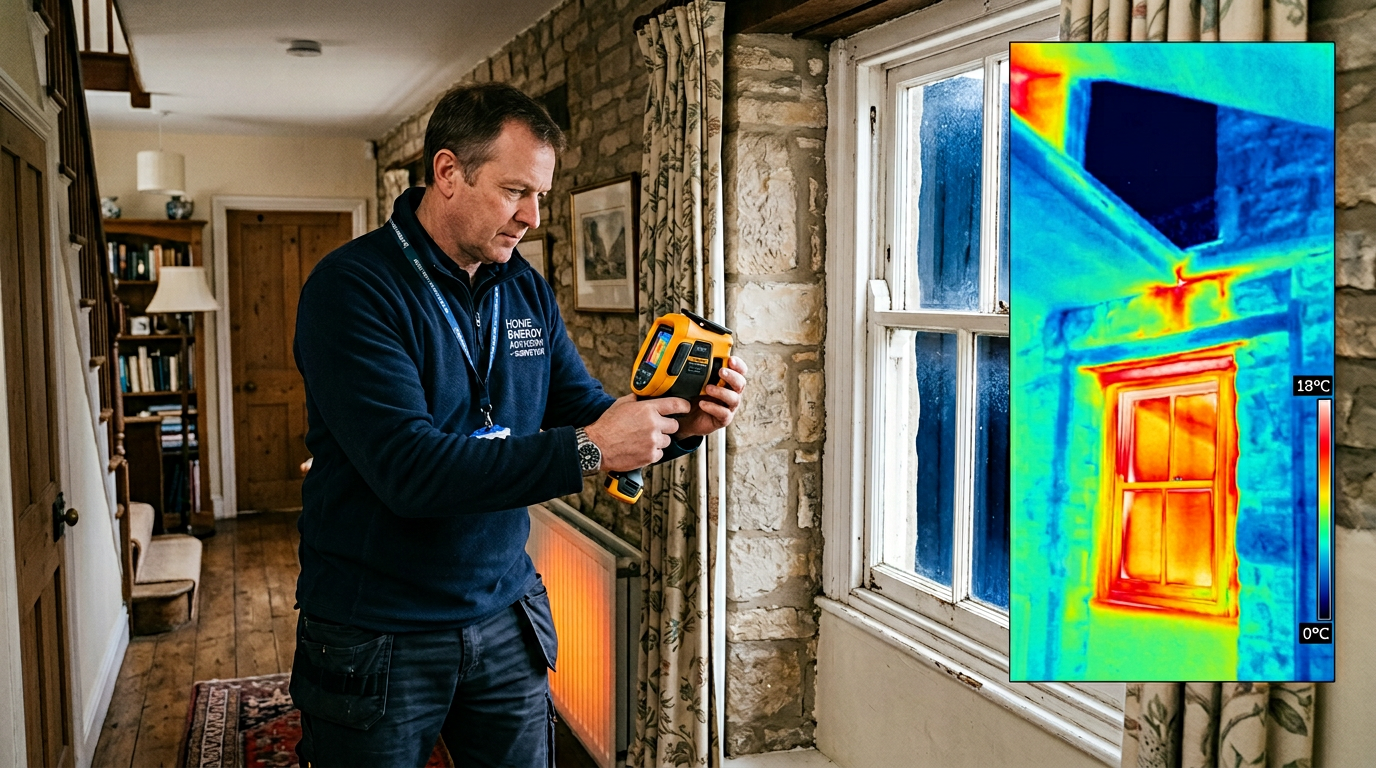
East Sussex is home to some of the most beautiful period properties in England — Victorian terraces in Crowborough, Edwardian villas near Tunbridge Wells, Georgian farmhouses in the High Weald. They are charming, characterful, and, in most cases, remarkably cold and expensive to heat. As a building surveyor who has been carrying out thermal imaging surveys across East Sussex for over a decade, I can tell you that the gap between how much energy an older home actually wastes and what its owners believe it wastes is consistently — sometimes startlingly — large.
This guide explains what thermal imaging and energy surveys reveal, how to read and improve an Energy Performance Certificate rating, and how to prioritise upgrades to get the best return on your investment without compromising the character of your home.
Why Do Older Homes Lose So Much Heat?
A pre-1919 property was built before any insulation standards existed — before cavity walls, before loft insulation requirements, before double glazing. The walls were solid masonry, often just 225mm of brick. The roof was uninsulated. The floors were suspended timber with gaps for draughts. Windows were single-glazed in poorly fitting timber frames. There was no continuous air barrier anywhere in the building fabric.
The result is a building that loses heat through every surface, in every direction, continuously. On a cold winter's day in Crowborough — and with the High Weald's elevation, temperatures here are routinely lower than the surrounding towns — an unimproved Victorian house can lose heat through its walls at a rate fifteen to twenty times faster than a modern well-insulated home of the same floor area.
| Building Element | % of Total Heat Loss (unimproved) | U-Value Unimproved | U-Value After Upgrade |
|---|---|---|---|
| Walls | 35% | 2.1 W/m²K | 0.3–0.6 W/m²K |
| Roof / loft | 25% | 2.3 W/m²K | 0.13–0.16 W/m²K |
| Windows & doors | 20% | 4.8–5.5 W/m²K | 1.4–1.8 W/m²K |
| Floor | 10% | 0.7 W/m²K | 0.22–0.25 W/m²K |
| Draughts / ventilation | 10% | N/A | Controlled ventilation |
What Thermal Imaging Surveys Reveal
A thermal imaging survey uses an infrared camera to show the surface temperatures of building elements. Cooler surfaces (losing more heat) appear in blue and purple; warmer surfaces (retaining heat better) appear in yellow and red. The resulting images are dramatically revealing — and in my experience, they consistently show three things that surprise homeowners:
1. Cold bridges are far more extensive than expected. Every structural element that bypasses the insulation layer — wall ties, lintels, structural beams, junction between wall and floor — shows as a cold stripe or patch on the thermal image. In solid-walled Victorian properties, the entire external wall is essentially one continuous cold bridge.
2. Air infiltration is the biggest underestimated problem. Draughts around skirting boards, through suspended timber floors, around window frames, through loft hatches and around pipe penetrations show up vividly on thermal images — often as bright cold patches in places the homeowner never suspected. Air infiltration accounts for up to ten per cent of heat loss in older homes and is often the cheapest to address.
3. Loft insulation is frequently inadequate or missing in patches. Many homes have some loft insulation, but thermal surveys regularly reveal areas where it has slipped away from the eaves, been disturbed by loft boarding, or simply was never installed properly. These gaps can represent a significant fraction of total roof heat loss despite the rest of the loft being reasonably well insulated.
Understanding Your EPC Rating
An Energy Performance Certificate (EPC) rates a property's energy efficiency on a scale from A (most efficient) to G (least efficient). Most unimproved pre-1919 properties in East Sussex fall in band E or F. Government targets increasingly require rental properties to meet band C or above, and future legislation is expected to extend similar requirements to sales.
Moving from band F to band C in a typical Victorian terraced house in East Sussex is achievable — but requires a planned programme of upgrades. The most impactful measures, in order of typical cost-effectiveness, are loft insulation, draught-proofing, cavity wall insulation (where applicable), and window upgrades. External wall insulation is highly effective but more expensive and visually significant.
Listed Buildings and Conservation Areas in East Sussex
Many properties in Crowborough, Forest Row, and across the High Weald AONB are listed or in conservation areas. Standard insulation approaches — external wall insulation, replacement windows — may not be permitted. Our surveyors can advise on sympathetic, consent-compliant approaches to energy improvement for listed and historically sensitive buildings, including breathable insulation systems, secondary glazing, and heritage-compatible draught-proofing.
Priority Upgrades: Best Value for East Sussex Homeowners
Loft Insulation (270mm mineral wool)
The single most cost-effective improvement for most older homes. Reduces roof heat loss by up to 90%.
Draught-Proofing
Sealing gaps around windows, doors, floorboards and skirting. Cheap, non-invasive, and highly effective.
Cavity Wall Insulation
For properties built post-1920 with unfilled cavities. Injected insulation reduces wall heat loss by ~65%.
Double / Secondary Glazing
Double glazing for cavity wall homes; secondary glazing for listed buildings or where character matters.
Internal Wall Insulation (solid walls)
Reduces wall heat loss by ~70% in solid-walled homes. Involves loss of internal floor area and requires full redecoration.
External Wall Insulation (solid walls)
Very effective for solid-walled homes; preserves internal space but changes external appearance. May require planning consent.
Heat Pump (Air Source)
Very low carbon heating when paired with good insulation. Most effective in well-insulated homes. Government grants (BUS) available.
Solar PV Panels
Generates electricity to offset bills. Works well on south-facing roofs. Consider battery storage for evening use.
Case Study: Victorian Semi in Crowborough — F to C in Three Years
A client purchased a three-bedroom Victorian semi-detached house in central Crowborough with an EPC rating of F (31). The property had original single-glazed sash windows, solid brick walls, and a partially insulated loft with significant gaps. Annual energy bills were approximately £3,200.
We carried out a thermal imaging survey and produced a prioritised improvement plan. In year one, the client had the loft insulation improved to 270mm and all accessible draught gaps sealed — total cost £950. Annual bills fell to approximately £2,700. In year two, they installed secondary glazing to the front elevation (where the original sashes were worth preserving) and replaced the rear windows with sympathetic timber double-glazed units — cost £4,800. Bills fell to £2,300. In year three, they installed internal wall insulation in the rear rooms during a planned kitchen renovation — cost £6,500 integrated into the wider kitchen project. Bills fell to £1,750.
After three years and a total investment of approximately £12,250 (excluding the kitchen renovation costs), the property's EPC had risen to C (72). Annual energy bills had fallen by nearly £1,500. The improvement in comfort — no cold walls, no draughts, even temperatures throughout — was described by the client as transformational.
Boiler, Heating System and Controls
Before investing heavily in fabric upgrades, it is worth ensuring your heating system is working efficiently. An old, poorly maintained boiler can waste 20–30% of the energy it consumes. Modern condensing boilers achieve efficiencies above 90%. A new A-rated boiler with smart thermostatic controls and room-by-room temperature management can cut heating bills by 15–20% independent of any fabric improvements.
Radiator balancing — adjusting the flow to radiators so heat is evenly distributed — is a simple, free adjustment that many systems never receive. Thermostatic radiator valves (TRVs) on every radiator except the one in the room with the main thermostat allow room-by-room temperature control and can reduce heating costs by 10–15%.
Government Grants and Funding for East Sussex Homeowners
Several government schemes are currently available to help fund energy improvements in East Sussex:
- Great British Insulation Scheme (GBIS): Funded insulation for homes in EPC bands D–G, with priority for lower-income households
- Energy Company Obligation (ECO4): Insulation and heating upgrades for eligible households, funded by energy suppliers
- Boiler Upgrade Scheme (BUS): £7,500 government grant towards an air source heat pump
- East Sussex County Council energy advice: Free home energy surveys for qualifying residents
Eligibility criteria change regularly. A thermal imaging survey from an independent surveyor provides the technical evidence base needed to access many of these schemes and ensure you are applying for the right improvements in the right order.
Frequently Asked Questions About Energy Efficiency Surveys
What is the difference between an EPC and a thermal imaging survey?
An EPC is a calculated estimate of energy performance based on standard assumptions about the building fabric and services. It does not physically inspect for heat loss. A thermal imaging survey physically measures surface temperatures to identify actual heat loss pathways, cold bridges, air infiltration points and insulation gaps. The two complement each other: the EPC shows the overall rating; the thermal survey shows where the heat is actually going.
When is the best time to carry out a thermal imaging survey?
Thermal imaging surveys are most effective when there is a significant temperature difference between inside and outside — ideally at least 10°C. In East Sussex this means October through to March, when the heating is on and external temperatures are low. Summer surveys are rarely informative as there is insufficient temperature differential to show meaningful heat loss.
Can I insulate a solid-walled period property without affecting its character?
Yes, with careful specification. Internal wall insulation using slim aerogel or phenolic boards can achieve significant improvement with minimal space loss. Secondary glazing preserves original windows while dramatically reducing heat loss. Breathable insulation systems are appropriate for listed buildings. The key is engaging a surveyor with experience of period property energy improvement — a blanket EPC assessor is unlikely to give appropriate advice for heritage buildings.
Will energy improvements affect my property value in East Sussex?
Yes — increasingly so. Research consistently shows that properties with EPC ratings of C or above command a premium over equivalent properties in band D or below. As minimum EPC requirements for rental properties tighten and buyer awareness of energy costs increases, a poor EPC rating is becoming a price-depressing factor. Improving energy efficiency is both personally beneficial and commercially sensible.
Does cavity wall insulation cause damp in East Sussex's climate?
In exposed locations — and parts of the High Weald around Crowborough are among the most exposed in East Sussex — there is a genuine risk that cavity wall insulation can allow wind-driven rain to bridge the cavity and cause internal dampness. The risk depends on the property's exposure rating, wall construction, and the condition of the outer leaf of masonry. A surveyor's assessment of exposure risk is essential before installing cavity wall insulation in an exposed location. In some cases, external render or cladding may be a better approach.
Start with the Survey, Then Plan the Upgrades
The most common mistake homeowners make with energy improvements is acting on the basis of an EPC alone — installing the measures it recommends without understanding the actual condition of their building fabric. A thermal imaging survey, commissioned alongside a building survey, gives you an accurate picture of where your home is losing heat and allows you to prioritise improvements rationally and cost-effectively.
At Crowborough Surveyor, we carry out thermal imaging surveys and energy improvement assessments across East Sussex. Whether you are planning upgrades on your existing home or assessing an older property before purchase, our surveyors can help you understand the full picture. Get in touch for a free, no-obligation quote.
Book a Thermal Imaging Survey
Find out exactly where your home is losing heat and get a prioritised improvement plan from our East Sussex surveyors.
Get a Free Quote